
Could a tempting cross-border route ever outweigh a country’s push for control? The question matters because a near-complete Trans-Guinean rail-and-port project has shifted the balance of power over bulk exports.
The government in Conakry has built a roughly 650 km line with major operators like Rio Tinto, Winning Consortium Simandou, and Compagnie du TransGuinéen lined up to run capacity at scale.
Meanwhile, Monrovia is advancing a US$1.8 billion Rail Access Agreement with Ivanhoe Atlantic to open the Yekepa–Buchanan corridor, but key written consent from the Guinean government is absent.
This matters beyond logistics. Allowing a foreign corridor would add political and economic risk to resource exports and weaken government control over pricing, scheduling, and compliance. In short, the present facts make a cross-border deal a risky option compared with a domestic, sovereignty-first export strategy.
Key Takeaways
- Conakry’s near-complete rail-and-port project reduces the need for a foreign route.
- Written authorization rules exist and have not been granted for cross-border shipments.
- Economic and political risks favor keeping exports under national oversight.
- Major industry players are committed to the domestic route, making it operationally credible.
- Any company pushing a Liberia corridor must first resolve intergovernmental consent.
News lede: Liberia advances a rail access deal while Guinea stays silent, raising viability and diplomatic questions
A proposed concession for the Yekepa–Buchanan corridor is moving through Liberia’s committees while a neighboring capital stays silent. President Joseph Nyuma Boakai submitted a US$1.8 billion Rail Access Agreement with Ivanhoe Atlantic to the legislature to use the line and Buchanan port.
What the HPX/Ivanhoe-Liberia arrangement would grant
The draft agreement would give HPX/Ivanhoe rail access on the Yekepa–Buchanan route and port use for bulk shipments. Supporters frame it as modernization of national infrastructure and new jobs.
Legal gaps and the need for written consent
Under a 2021 transshipment framework, prior written authorization from the guinean government is required. That formal consent is absent, creating a clear legal exposure and a potential challenge to any ratified arrangement.
Legislative stakes and operational friction
Liberia’s committees are reviewing a 25-year Concession and Access agreement. Adding another user could trigger scheduling and usage rights disputes on a system already serving ArcelorMittal Liberia.
The confidential diplomatic note warns that ratification without explicit consent risks political, legal, and financial fallout.
- Practical risk: investors and mining companies should confirm legal preconditions before committing.
- Policy risk: permitting cross-border exports would weaken export control and create exposure for the other government.
Trans-Guinean Railway near completion: the strategic alternative that secures Guinea’s iron ore exports
With testing under way, a homegrown rail port solution is shaping export options for Simandou partners.
Specs and status: The trans-guinean railway is a purpose-built, multi-use corridor of roughly 600–650 km. It links mines to a deep-water port using barge and transshipment vessel facilities. Testing and commissioning are active and the system is moving material from mine gate to port, with a ramp-up target of up to 120 mtpa.
Control and governance: Compagnie du TransGuinéen (CTG) will operate the infrastructure and rolling stock after commissioning. Equity is split: SimFer and WCS each hold 42.5% and the government guinea holds 15%. This setup preserves sovereign oversight while keeping private operators like rio tinto engaged in operations and development.
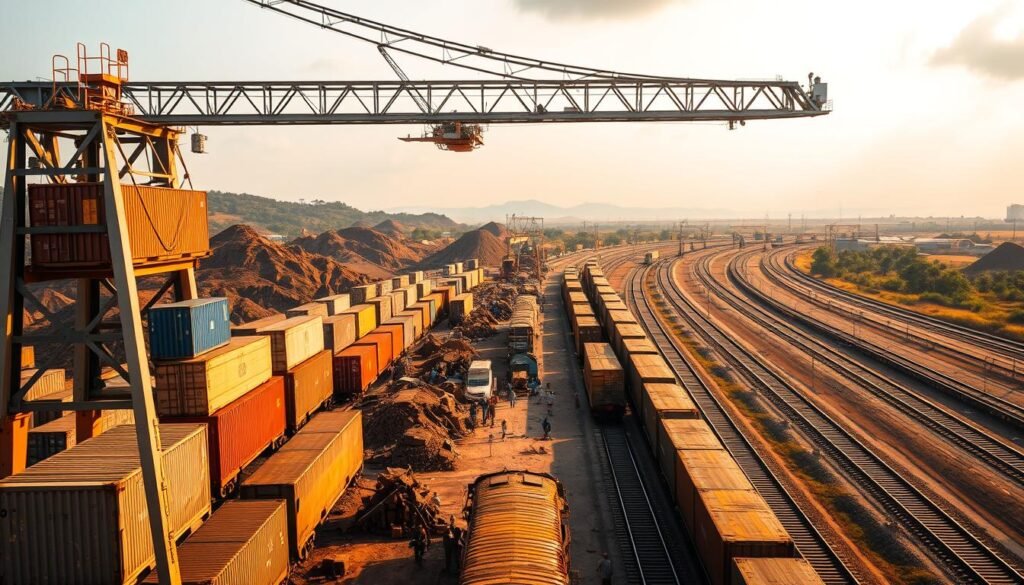
“The integrated rail and port framework gives the state direct control of scheduling, tariffs, and compliance while enabling large-scale exports.”
| Feature | Detail | Impact |
|---|---|---|
| Length | 600–650 km | Connects inland mines to Atlantic waters |
| Capacity | Up to 120 mtpa | Supports large-scale export contracts |
| Governance | CTG (SimFer 42.5%, WCS 42.5%, government 15%) | Sovereign oversight with private efficiency |
| Investment | ~US$18 billion | Long-term development and export security |
- One corridor: consolidated rail port infrastructure reduces cross-border complexity.
- Operational readiness: commissioning is measured in months, not years.
- Industry backing: rio tinto, WCS, Baowu, and Chinalco align on construction and operations.
Why guinea iron ore will not transit through Liberia: economic, legal, and political realities
Practical and legal factors make a cross-border export route unlikely and risky. The trans-guinean railway and its port are nearing completion and already change the economics of routing ore abroad.
Economic calculus: A domestic rail and port in testing removes extra fees, tariffs, and handovers that a foreign corridor would add. A roughly 67 km in-country spur from Nimba to the national line is shorter and cheaper than routing material via an external route.
Legal and sovereignty hurdles: Prior written authorization under the 2021 transshipment framework is required. That consent is absent, so any access agreement risks breaching law and opening arbitration over rights and contractual terms.
Diplomatic and security risks: Moving export access without clear approval could prompt fallout with regional partners and strain ECOWAS cooperation. Arbitration and political friction would raise costs and threaten export receipts.
Timing and operations: Simandou testing and commissioning, plus integrated port capacity targeting up to 120 mtpa, mean the national route will reach steady operations first. For companies, the investment and operational risk of an external arrangement outweigh potential gains.

“With infrastructure nearly complete and legal frameworks in force, routing a major export via a foreign corridor introduces avoidable exposure.”
| Factor | Domestic route | Cross-border option |
|---|---|---|
| Distance | ~67 km spur to national line | Longer routing and extra interfaces |
| Legal clearance | Under national control, authorized by government guinea | Requires prior written consent; absent today |
| Operational readiness | Rail testing and commissioning underway; up to 120 mtpa target | New permits, integration and scheduling delays likely |
| Political risk | Sovereign oversight reduces exposure | High risk of arbitration and diplomatic fallout |
- Bottom line: economic sense, law, and timing all favor the national corridor for export of iron ore.
Conclusion
With commissioning under way and operators aligned, the national project offers the clearest path forward. CTG’s setup, backed by Rio Tinto, SimFer, WCS, Baowu and Chinalco, secures exports and reduces the legal and political risk of a cross-border deal.
The evidence on policy, development and timing points to keeping ore on the domestic corridor. For a company or investor, prioritizing rail access inside the national system is the prudent choice after years of build-out and testing.
In practical terms, the safest route for revenue, schedules and compliance is domestic operations. That approach protects government interests, preserves patience between countries, and keeps future cooperation on clearer terms.